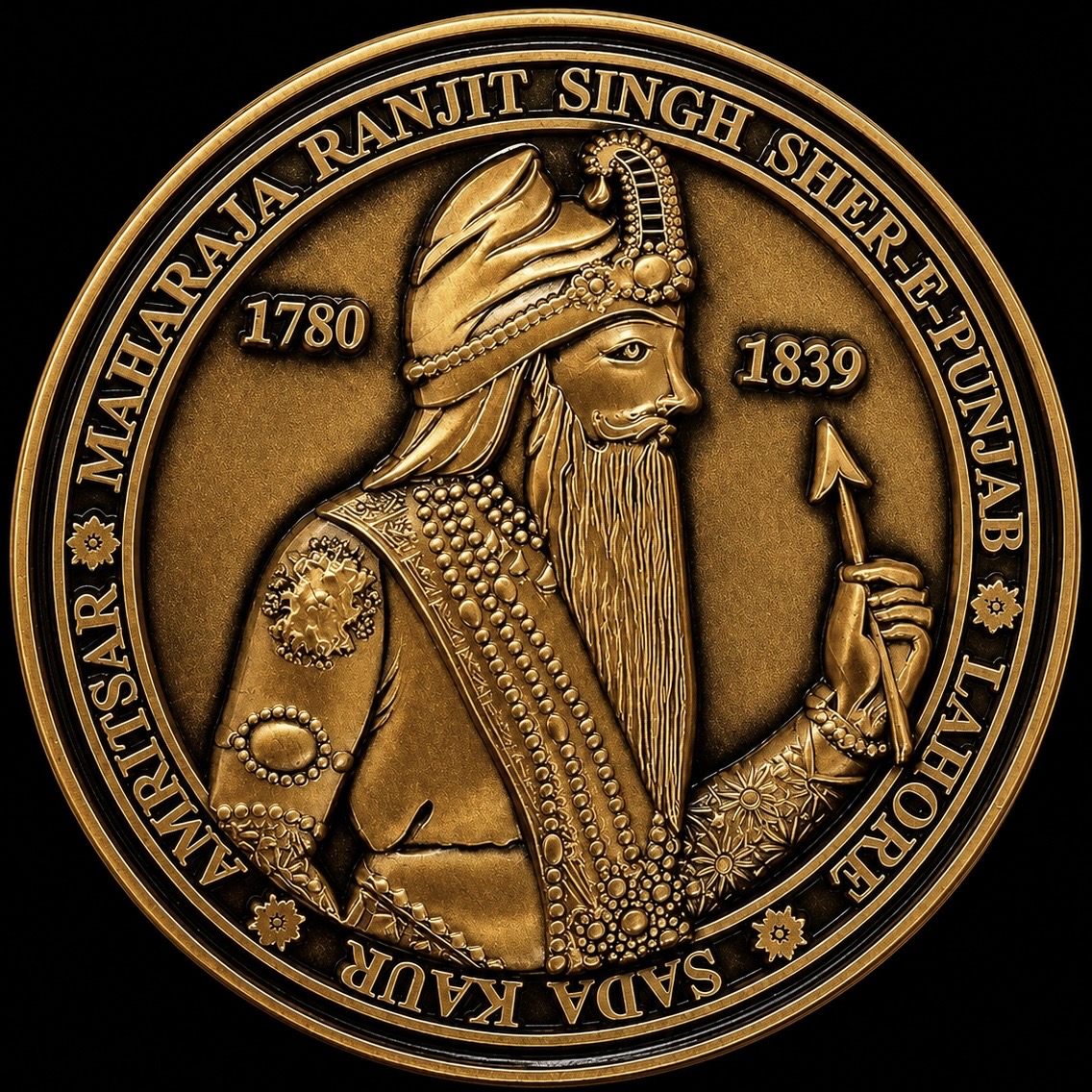
Known as Sher-e-Punjab — the Lion of Punjab — Maharaja Ranjit Singh rose from hardship to unite a fragmented land into one of the most formidable kingdoms of nineteenth-century South Asia.
Born in Gujranwala in 1780, he lost sight in one eye to smallpox as a child yet grew into a leader of exceptional military and political skill. By 1801 he had been crowned Maharaja of Punjab. Over the next four decades he expanded his domain from the Khyber Pass to the Sutlej, creating a stable, prosperous state at a time when much of the subcontinent faced colonial pressure.
Ranjit Singh's court blended Sikh, Hindu, and Muslim traditions. He restored sacred sites, patronised poets and painters, and maintained a disciplined army that combined European artillery with Khalsa valour. His governance emphasised merit over birth — soldiers and ministers could rise through ability regardless of faith. (Wikipedia)
The Lahore Darbar became a centre of culture: the Harmandir Sahib was gilded in gold, the toshakhana filled with jewels and manuscripts, and trade flourished across Punjab's five rivers. Foreign observers noted both the strength of his army and the relative tolerance of his rule compared to many contemporaries.
After his death in 1839, the kingdom faced succession struggles and eventually fell to British expansion. Yet his memory endured — in folk song, in historical writing, and in the pride of Punjabis worldwide who see in him a model of unity, resilience, and self-determination.
Maharaja Coin takes cultural inspiration from this legacy. We do not speak for historians, governments, or descendants of the Lahore court. We simply invite our community to remember a figure who showed that a wounded boy could become a maharaja, and that an empire built on pluralism could shine brightly in a turbulent age.